
The Rise of the Virtually Integrated Site Network: A New Business Model for Clinical Research
In a landmark 1998 Harvard Business Review interview, Michael Dell of Dell Computers introduced the concept of “virtual integration," describing how independent organizations could function as a highly coordinated enterprise without common ownership.
Rather than owning a single huge Ford-style factory, Dell demonstrated that carefully coordinated relationships between independent businesses could achieve many of the same operational advantages as common ownership. Nearly three decades later, that same business strategy is beginning to reshape the clinical research industry.
Historically, clinical research has followed the classic ownership model. The one thing that universities, hospitals, site networks, and standalone sites all have in common is that the party contracting with the sponsor owns and controls the entire research enterprise. They own the physical space, employ the physicians and research staff, and manage the compliance functions. Increasingly, however, entrepreneurs are assembling research organizations in a different way.
Rather than acquiring physician practices or research sites, they are knitting together independent organizations into a coordinated enterprise that collectively performs the research while remaining under separate ownership.
Borrowing from Dell's concept of virtual integration, I refer to these emerging organizations as Virtually Integrated Site Networks (VISNs).
From a business perspective, the strategic advantage of the VISN is that it allows entrepreneurs to build research capacity by leveraging infrastructure that already exists rather than recreating it.
Instead of acquiring physician practices, constructing facilities, and hiring an entirely new workforce, a VISN can be operated by a small group of research experts who orchestrate a constellation of specialized organizations including physician practices, principal investigators, regulatory professionals and other service providers. Investors gain access to scalable research capacity without the capital requirements associated with acquiring and integrating entire organizations.
The model also allows each participant to remain focused on its core competency. The result is an organization that has the potential to scale more quickly than one built through acquisition alone.
With that said, it is important that entrepreneurs setting out on this path understand that the legal work needed to support this type of VISN requires a degree of precision and planning more commonly associated with systems engineering than contract drafting.
In an ownership-based system, contracting is much simpler. The primary vehicle is the clinical trial agreement (CTA) with sponsor which is a templated agreement that may require revisions but will not require novel architectural design.
In the VISN model, the CTA still provides the primary link between the site and sponsor, but there must also be a network of service agreements behind the scenes that knit the distinct participating entities together.
And each of those contractual relationships must be very carefully designed to ensure that the right obligations are delivered to the right parties in a legally binding way that matches the upstream sponsor’s terms.
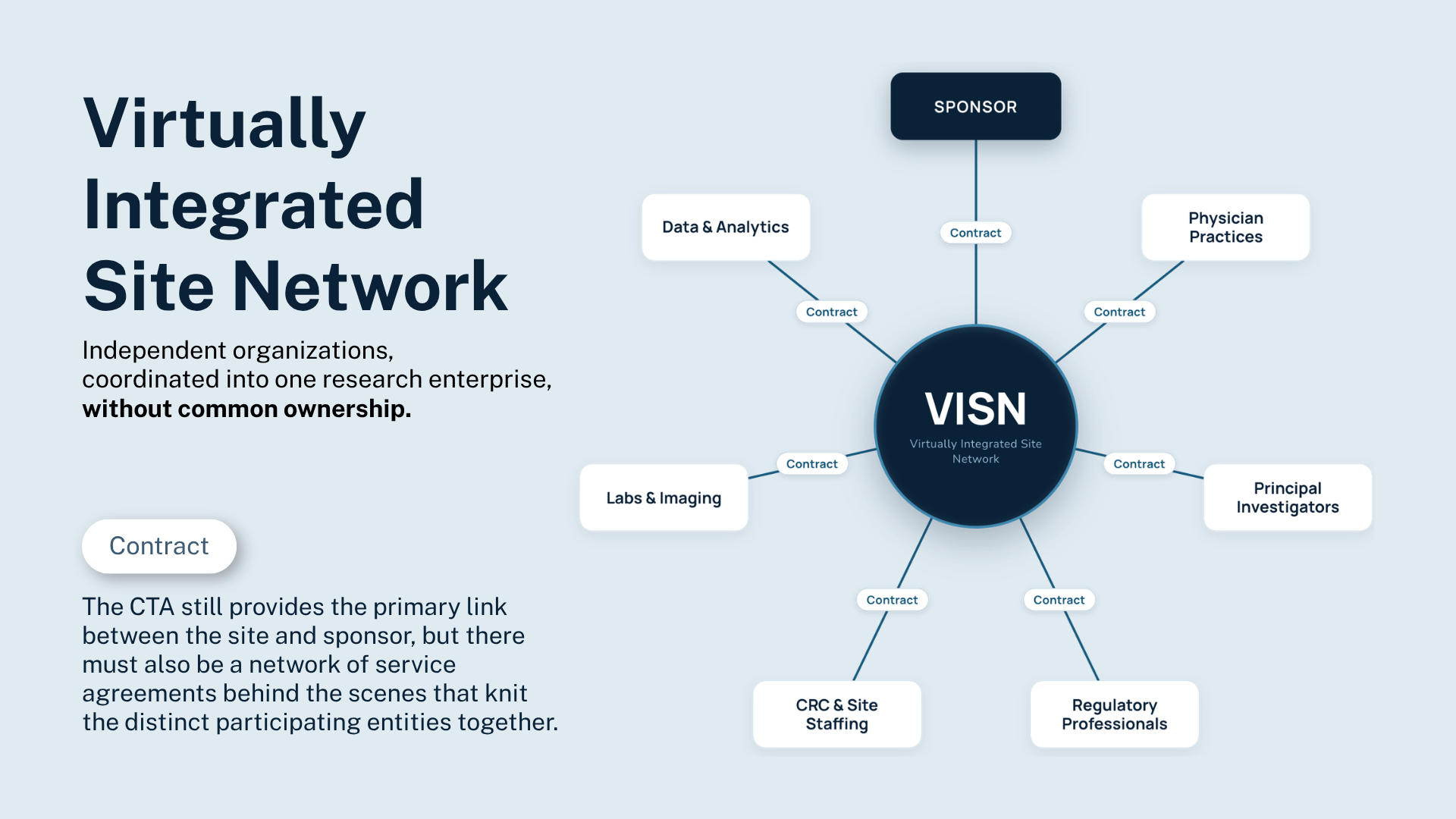
Consider a simple example. A sponsor's CTA will always require very specific limitations around confidentiality, data ownership, and publication. An agreement to retain a principal investigator must pass down those terms with identical or more restrictive terms otherwise the VISN is in breach of the sponsor’s CTA. The challenge is compounded by the fact that each sponsor's contractual requirements differ slightly, while the work being performed changes with every protocol. This prevents a one-size-fits all build-it-and-leave-it approach.
The agreements cannot be drafted in isolation; they must be engineered as an integrated system of contracts.
Michael Dell demonstrated nearly three decades ago that common ownership was not the only path to building a highly coordinated enterprise. Clinical research is now beginning to discover the same principle. Virtually Integrated Site Networks offer entrepreneurs and investors an opportunity to build research capacity with remarkable speed and capital efficiency. But unlike Dell's supply chain, a VISN operates within one of the most heavily regulated industries in the economy. Success therefore depends not simply on operational excellence, but on legal architecture capable of transforming independent organizations into a coordinated research enterprise.
In the emerging VISN model, contracts are no longer just legal documents. They are the infrastructure that makes the enterprise possible.
Building a VISN, or trying to make sense of the contractual architecture behind one?
Reach out to learn more about structuring a legally sound, scalable research network.